
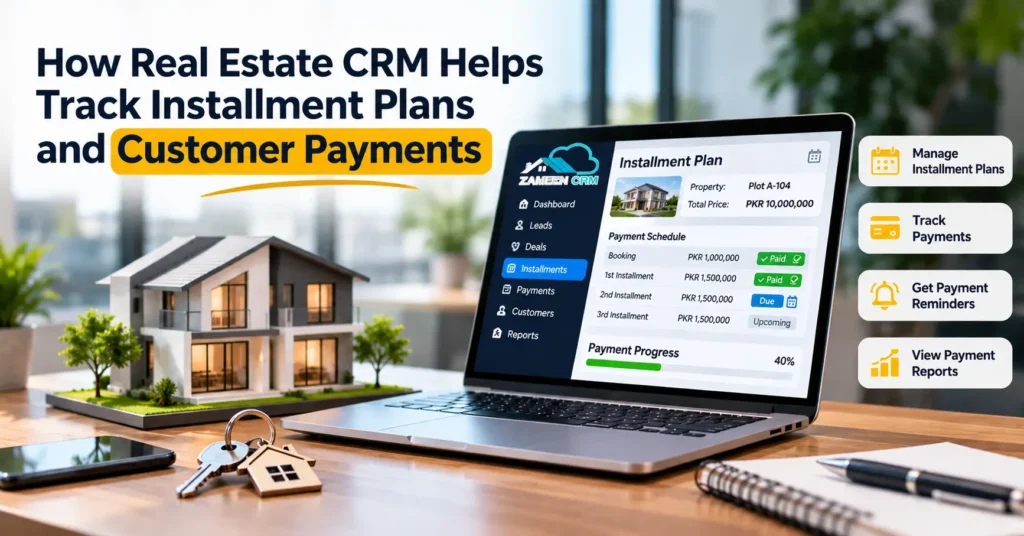
Selling property on installments sounds simple until you’re actually managing fifty buyers on fifty slightly different schedules. One spreadsheet for who’s paid, another for who’s overdue, a third the finance team keeps that never quite matches what sales is telling customers. It adds up fast, and it falls apart faster.
A real estate CRM fixes this by creating payment schedules, keeping a live customer ledger, tracking what’s coming due and what’s already overdue, and tying all of that directly to the property sale it belongs to. At Zameen CRM, this is usually the exact pain point that gets a developer or agency looking for something better than spreadsheets in the first place.
How Does a Real Estate CRM Manage Installment Plans?
Create Custom Payment Plans
No two buyers pay the same way, and a good CRM doesn’t force them to. It handles:
- Down payments
- Monthly installments
- Quarterly installments
- Bi-annual payments
- Milestone-based payments tied to construction progress
Automate Payment Calculations
Once a plan is set, the system tracks the moving parts on its own:
- Total property price
- Amount already paid
- Remaining balance
- Next upcoming installment
- The full payment schedule going forward
Nobody’s manually recalculating a balance every time a payment comes in. It just updates.
Real-Time Customer Payment Tracking
A customer ledger that actually stays current changes how sales and finance teams work together. Instead of chasing each other for updates, both sides look at the same numbers:
- Total property value
- Amount paid to date
- Outstanding balance
- Upcoming dues
- Full payment history
- Overdue installments, flagged clearly
When sales and finance are pulling from one shared ledger instead of two separate files, the awkward “let me check with finance and get back to you” moment mostly disappears.
Automated Payment Reminders and Collections
Time chasing payments by hand is time wasted on something no one can afford to spend. Automated workflows do the repetitive job of notifying customers via SMS, WhatsApp, or email, whichever mode succeeds in getting a reaction out of that customer.
Track Overdue Payments
Aging buckets make overdue tracking a lot less chaotic. Most systems sort overdue accounts into simple stages, something like:
- 30 days overdue
- 60 days overdue
- 90+ days overdue
That kind of breakdown tells collections exactly where to focus first instead of treating every late payment the same way.
Milestone-Based and Recurring Payment Plans
Real estate payment structures generally fall into two camps.
Milestone-based payments tie installments to actual construction progress, so buyers pay as the project physically moves forward rather than on a fixed date regardless of progress.
Recurring installments work on a set calendar instead, monthly, quarterly, or bi-annual payments that don’t depend on any particular milestone being hit.
A CRM built for real estate payment plans needs to handle both without forcing every buyer into the same rigid structure.
Real Estate CRM for Sales and Finance Coordination
Before CRM, the usual setup looks something like this. Sales keeps one record. Finance keeps another. Payment information gets fragmented between the two, and customer follow-ups get delayed while someone tracks down the right number.
With CRM, that gap closes. Shared customer information, updated payment status visible to both teams, one centralized ledger instead of two competing versions, and noticeably better communication between departments that used to work in silos.
Wondering how this would actually look for your sales and finance teams? Zameen CRM can walk you through it. Call +61 491 678 165 or email info@zameencrm.com.
Real Estate CRM Payment Management vs Manual Tracking
| Feature | Manual Tracking | Real Estate CRM |
| Payment schedules | Spreadsheets | Centralized system |
| Installment calculations | Manual | Automated |
| Customer ledger | Separate files | Centralized |
| Payment reminders | Manual follow-up | Automated alerts |
| Overdue tracking | Difficult to monitor | Organized tracking |
| Sales & finance coordination | Disconnected | Shared information |
How CRM Supports Commission and Revenue Forecasting
Payment data doesn’t just help collections, it feeds straight into commission tracking and planning too. As installments come in, commission calculations can be tied directly to actual payments received rather than guessed at manually.
That same data gives management real visibility into revenue forecasting, since the active installment pipeline shows exactly how much expected revenue is sitting in signed contracts, not just what’s already been collected. Future payment visibility like that makes cash flow planning a lot less of a guessing game.
Key Benefits of Real Estate CRM for Installment Management
Once it’s running day-to-day, the practical wins tend to be:
- Centralized payment information instead of scattered files
- Far fewer manual calculations
- Better installment visibility across every active buyer
- Automated customer reminders that don’t depend on someone remembering
- Easier overdue payment tracking through clear aging stages
- Improved coordination between sales and finance
- Better revenue visibility for leadership and planning
Frequently Asked Questions
What is a real estate CRM?
A real estate CRM is software designed for managing all aspects of property sales, customer relations, and accounting in one integrated package, which eliminates the need for spreadsheets and multiple accounts across various departments.
How does CRM help real estate businesses manage payments?
The real estate CRM system maintains all the information related to payment schedules; how much is paid and what is pending can be monitored through this system, thus providing an update to all departments about customers’ payments.
How can a real estate CRM manage installment plans?
It generates customized payment schedules taking into account the initial deposits, monthly or quarterly payments, milestone-based payments, and computes the remaining balance and future payments.
What are the benefits of automated payment reminders in real estate?
Automated reminders prevent defaulters, minimize time spent by employees in following up manually, and increase collection efficiency by communicating to customers via SMS, WhatsApp, or email before and after deadlines.
How does a property CRM track customer installments?
A property CRM maintains a customer ledger showing total property value, amount paid, outstanding balance, and payment history, updating automatically as each installment is recorded.
Can real estate CRM software generate payment schedules?
Yes, real estate CRM software can generate payment schedules automatically based on the property price, chosen payment plan, and installment frequency selected for each customer.
How does CRM improve coordination between sales and finance teams?
CRM improves coordination by giving both teams access to the same centralized customer ledger, eliminating the fragmented records and delayed follow-ups that come with separate manual systems.
Can a real estate CRM track overdue property payments?
Yes, a real estate CRM tracks overdue payments and typically organizes them into aging stages, such as 30, 60, and 90-plus days overdue, to help prioritize collections.
Conclusion
Managing installment-based property sales without a proper system usually means chasing numbers across spreadsheets that never quite agree with each other. A real estate CRM replaces that with one centralized ledger, automated payment calculations, and reminders that go out without anyone having to remember.
If your team is still piecing together payment status from multiple files, it’s worth seeing what a connected system actually looks like. Zameen CRM can show you how it fits your sales and finance workflow. Reach out at +61 491 678 165 or info@zameencrm.com.