
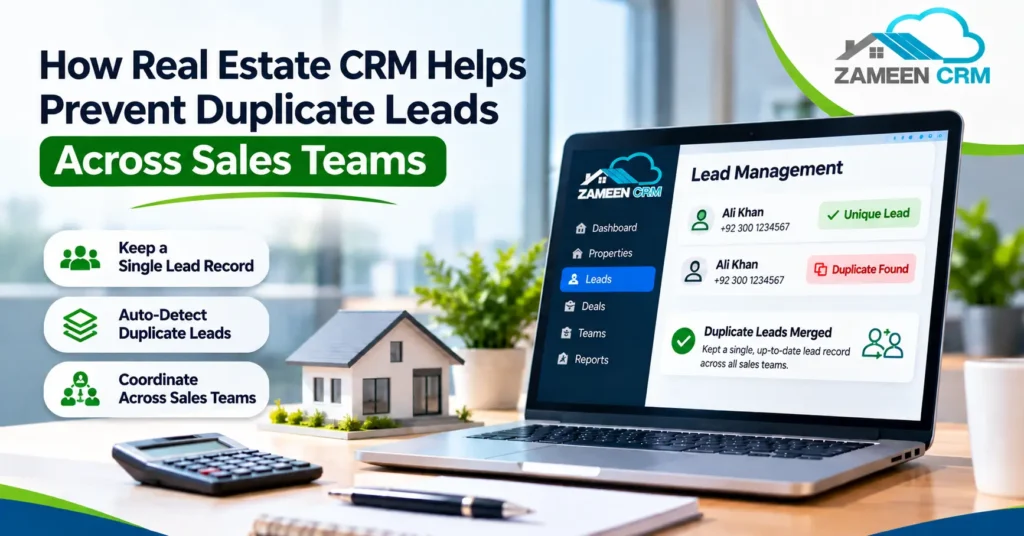
Same buyer, three touchpoints. They fill out a form on your website, message your Facebook page, then call in about the same listing a week later. Three agents now think they’ve each landed something fresh. And this is how the duplicate leads issue looks in brief. It constantly arises when inquiries begin coming in from different sources such as websites, portals, social networks, and advertising that do not communicate with each other.
How does the real estate CRM solve this issue? By making sure that all leads go into one database and by comparing each inquiry to the existing phone numbers, emails, and client lists. At Zameen CRM, this comes up a lot, usually right after two agents have already called the same buyer and things got a little awkward on the phone.
How Does a Real Estate CRM Prevent Duplicate Leads?
There is no duplication of leads in the real estate CRM because all the inquiries are stored in a single database, and then the system checks for duplication of phone numbers and email before adding another lead.
A few things make that work:
- A centralized lead database every source feeds into
- Automated duplicate detection running quietly in the background
- Phone and email matching against what’s already on file
- Existing-record identification before a new profile even gets created
- Automatic merging or flagging the moment a match turns up
4 Ways a Real Estate CRM Stops Duplicate Leads
1. Centralizes Leads From Multiple Sources
Inquiries come from more places than most teams realize until they actually map it out:
- Website forms
- Property portals
- Social media campaigns
- Walk-in inquiries
- Marketing campaigns
Get all of it into one system, and there’s no more website list quietly ignoring what the portal list already knows.
2. Detects Duplicate Contact Information
Lead duplication usually gets caught right at the door, through phone number matching, email matching, and a quick comparison against existing customer records. New inquiry matches something already on file? Flagged before it becomes a second, competing lead.
3. Merges New Inquiries With Existing Records
Instead of spinning up a fresh record every time someone reaches out again, the system keeps one customer profile, folds in the new property interest, holds onto the full history of past interactions, and skips creating a pointless duplicate.
4. Controls Lead Assignment
Lead ownership gets checked before anything else moves forward. The system confirms whether a lead’s already assigned, which is exactly what stops multiple agents from cold-calling the same buyer within the same week.
Why Duplicate Leads Are a Problem for Real Estate Teams
| Problem | Impact | CRM Solution |
| Duplicate customer records | Confusing data | Unified customer profile |
| Multiple agents contacting one buyer | Poor customer experience | Lead ownership |
| Inflated lead numbers | Inaccurate reports | Clean database |
| Lost interaction history | Missed opportunities | Centralized timeline |
It’s not just an internal headache either. A buyer who gets three separate calls about the same listing forms a pretty clear opinion about how organized that agency actually is, and it’s rarely a flattering one.

Real Estate CRM vs. Manual Lead Management
| Feature | Manual Spreadsheets | Real Estate CRM |
| Lead storage | Separate files | Centralized database |
| Duplicate detection | Manual | Automated |
| Lead assignment | Manual | Rule-based |
| Customer history | Difficult to track | Centralized |
| Reporting | Manual | Real-time |
| Follow-ups | Easy to miss | Automated |
Curious how this would actually play out in your own sales pipeline? Zameen CRM can walk you through it. Call +61 491 678 165 or email info@zameencrm.com.
What Information Does a CRM Use to Identify Duplicate Leads?
A handful of data points do most of the actual work:
- Phone number
- Email address
- Customer name
- Existing lead ID
- Previous inquiries
- Property interest
- Lead source
Phone and email matching tend to be the most reliable of the bunch. Names get spelled differently, shortened, or mistyped. A phone number or email stays the same no matter which channel someone reaches out through.
Benefits of Keeping a Clean Real Estate Lead Database
A properly deduplicated lead database pays off in more ways than just looking tidy on a dashboard:
- Better lead ownership across the whole sales team
- Fewer redundant calls hitting the same buyer twice
- More accurate sales reports, not inflated ones
- Cleaner marketing data for measuring what campaigns actually work
- A noticeably better customer experience
- Easier, less scattered follow-up
- More reliable conversion tracking from lead to sale
How to Choose a Real Estate CRM for Duplicate Lead Management
Shopping around? Focus on what actually solves this specific problem, not just feature-list padding:
- Reliable duplicate detection
- Lead merging that preserves history instead of wiping it clean
- Multi-channel integrations that cover your actual lead sources
- Lead assignment rules that prevent overlap
- A full customer activity timeline
- Reporting and analytics you can actually trust
- Automated follow-ups that don’t depend on someone remembering
Frequently Asked Questions
How does a CRM prevent duplicate leads?
By centralizing every inquiry into one database and automatically checking new leads against existing phone numbers and email addresses before a new record ever gets created.
What causes duplicate leads in real estate?
Usually the same buyer reaching out through multiple channels, a website form, a property portal, a social media ad, without those systems being connected.
How do you manage duplicate real estate leads?
Use a CRM that automatically detects matching contact information and merges new inquiries into an existing profile instead of spinning up a separate record each time.
How does CRM lead management work in real estate?
It pulls leads from every source into one system, checks for duplicates, assigns ownership to a single agent, and keeps the full interaction history in one place.
How can real estate agents avoid duplicate leads?
Work from a shared CRM that centralizes every inquiry and flags matching contact details before a new lead gets logged separately by a different team member.
Why are duplicate leads a problem for real estate businesses?
They create confusing data, lead to multiple agents chasing the same buyer, inflate lead numbers on reports, and cause interaction history to get scattered or lost entirely.
Can a CRM automatically merge duplicate leads?
Yes, most real estate CRMs can match contact information automatically and merge new inquiries straight into the existing customer profile rather than creating a new one.
What is the best way to organize real estate leads?
Through a centralized CRM that pulls in every source, catches duplicates automatically, and assigns clear ownership so agents aren’t stepping on each other.
Conclusion
A duplicate lead not only means redundant information but also represents an issue related to both customer experience and sales efficiency. An ideal real estate CRM addresses this issue by maintaining all inquiries and ensuring that there is consistency and clarity of ownership in the entire process.
Still juggling leads across spreadsheets and disconnected channels? Zameen CRM can show you what a properly deduplicated pipeline actually looks like. Reach out at +61 491 678 165 or info@zameencrm.com.