
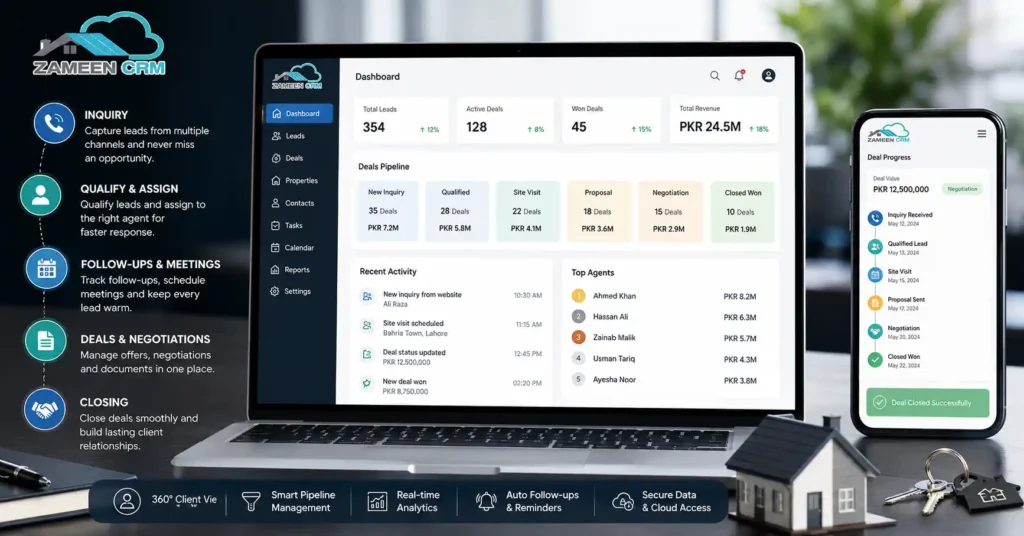
A lead came in through Zameencrm.com last month. Someone followed up once. Then things got busy, and nobody’s sure anymore if that client bought somewhere else or is still waiting on a call back.
That’s what happens when a deal runs through WhatsApp chats, a notebook, and whatever an agent happens to remember that week. First inquiry. A string of follow-up calls. A site visit pushed back twice. Weeks of negotiation back and forth. Somewhere in there, a token receipt and an NOC that still need chasing before anything can close. Miss one thread and the deal falls apart quietly, without anyone quite noticing until it’s too late.
A real estate CRM keeps client details, property activity, follow-ups, documents, and deal progress in one place. Not spread across five apps and a folder of paper. From the first inquiry to the day it closes. Here’s what that looks like.
What Is a Real Estate CRM?
Not just a contact list, though people sometimes treat it that way. A basic database stores names and numbers. A real estate CRM connects leads, property listings, agents, and Full Transaction History into one system that tracks how a deal actually moves.
Why Real Estate Businesses Need Deal Tracking
Skip proper tracking and the same problems show up. Follow-ups get forgotten. Inquiries land with one agent and never reach the right person. Client details end up split across three phones and an old email thread nobody checks. Whoever runs the business loses track of which deals are moving and which ones died two weeks ago.
How CRM Tracks a Property Deal From Inquiry to Closing
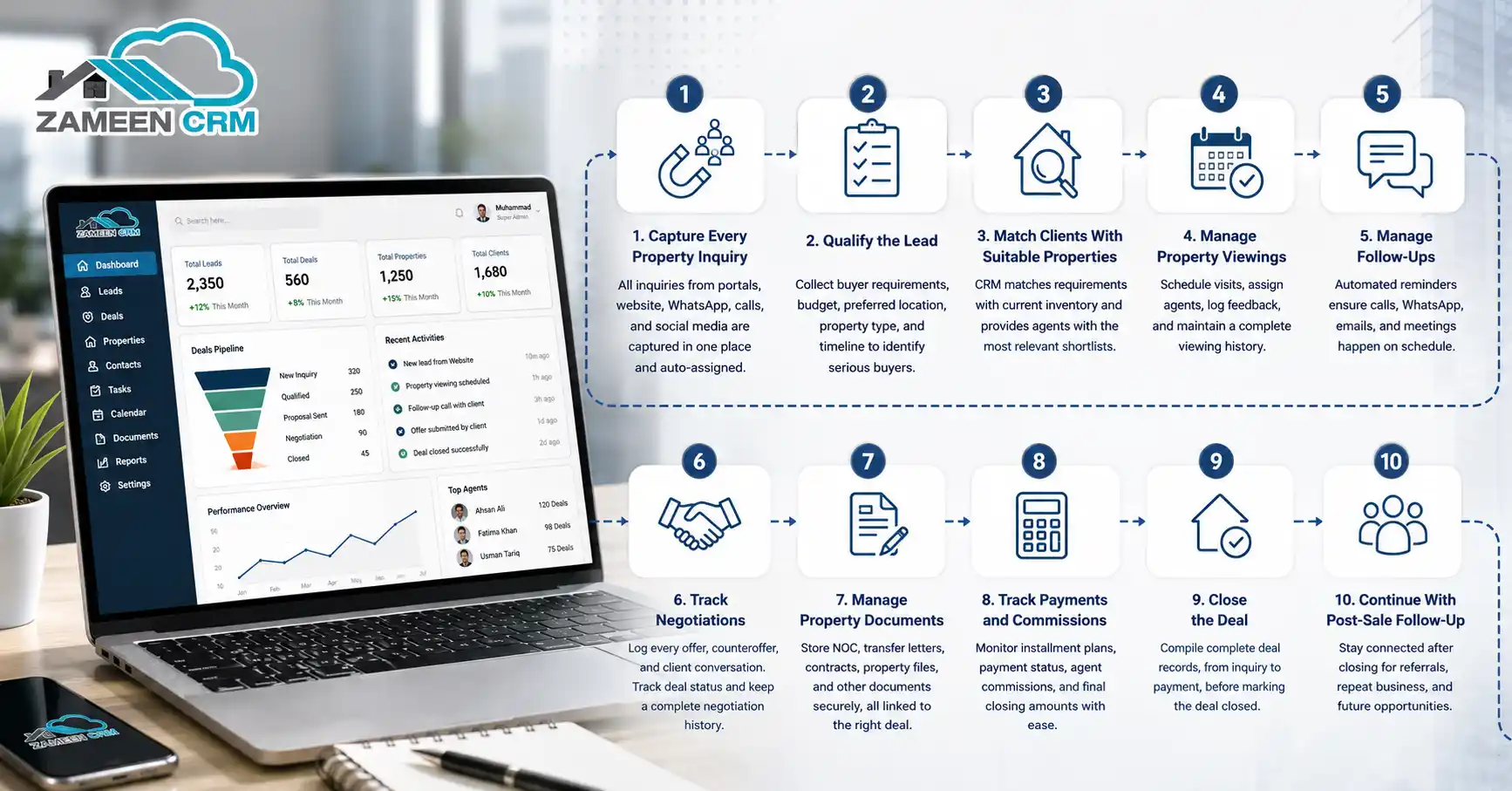
1. Capture Every Property Inquiry
Inquiries come from property portals, website forms, WhatsApp, phone calls, sometimes a comment on Facebook or Instagram. A CRM pulls all of that lead capture into one system and handles automatic lead assignment.
2. Qualify the Lead
Not everyone who messages is ready to buy this month. Lead qualification sorts out buyer requirements, budget, preferred location, property type, and purchase timeline early.
3. Match Clients With Suitable Properties
Once buyer requirements are clear, the CRM checks them against current property inventory. Agents get a shortlist instead of scrolling through listings from memory.
4. Manage Property Viewings
One site visit is easy to manage. Ten of them across different agents in the same week is not. The CRM handles scheduling, assigns the agent, logs client feedback, and keeps a full viewing history attached to the lead.
5. Manage Follow-Ups
This is where most deals get lost. Automated follow-up reminders make sure calls, WhatsApp messages, emails, and meetings happen on schedule.
Zameen CRM builds these follow-up workflows directly into the system.
6. Track Negotiations
Offers and counteroffers can drag on for weeks. The CRM logs every offer, every client conversation, and the current deal status. That history is there to reference if there’s ever a dispute over what was agreed.
7. Manage Property Documents
Local property deals come with their own paperwork: NOC, transfer letter, token receipt, property files, contracts. Document management inside the CRM keeps all of it tied to the right deal.
8. Track Payments and Commissions
Installment plans are common here, and tracking them by hand gets messy. The CRM keeps tabs on payment status, installment schedules, agent commission tracking, and final closing amounts.
9. Close the Deal
Before a transaction gets marked closed, the CRM pulls together the complete record. Every inquiry, viewing, negotiation, document, and payment tied to that deal, all in one place.
10. Continue With Post-Sale Follow-Up
The relationship doesn’t stop at closing. Post-sale follow-up keeps the door open for referrals, repeat purchases, and future opportunities.
Real Estate CRM Deal Pipeline Explained
New Inquiry → Qualified Lead → Property Matched → Site Visit → Negotiation → Documentation → Closing → Post-Sale
Every deal moves through these deal stages. The CRM shows agents and managers exactly where each one sits in the sales pipeline.
Key Benefits of Tracking Property Deals With CRM
- Fewer leads slipping through
- Faster response times on new inquiries
- Follow-ups that actually happen
- One place for client information instead of five
- Real visibility into active deals
- Agents held accountable
- Faster transaction management
- Better conversion rate tracking
Why Property Portal Integration Matters
Most property inquiries in Pakistan start on portals like Zameencrm.com. Without integration, someone manually copies leads into a spreadsheet or CRM. That manual step is where duplicate entries and missed leads creep in.
With integration set up, inquiries flow in on their own, get assigned right away, and land inside one communication history.
What Should a Real Estate CRM Include?
- Lead management
- Property inventory
- Sales pipeline tracking
- Site visit management
- Follow-up reminders
- Communication history
- Document management
- Payment tracking
- Commission management
- Sales analytics
Miss one of these and someone usually ends up back in a spreadsheet trying to patch the gap.
How CRM Helps Real Estate Businesses in Pakistan
- Property dealers tricking several active leads at once get every inquiry and follow-up in one place instead of split across personal WhatsApp chats.
- Real estate agencies running multiple agents get visibility into who’s handling what deal, without a daily status meeting.
- Developers selling units across a project track token payments, installment plans, and buyer documentation for every unit.
- Housing societies dealing with transfer requests and NOC processing get a cleaner paper trail for each transaction.
- Property investment companies tracking deals across cities get one dashboard instead of chasing updates city by city.
Curious how this fits your setup? Zameen CRM can walk you through a workflow built around local property business operations.
Frequently Asked Questions
How does CRM help real estate agents?
It keeps leads, follow-ups, property matching, and documents in one place. Agents spend less time searching and more time closing.
How does CRM help track property leads?
Every inquiry gets logged from wherever it came from, then assigned to an agent and followed through the pipeline.
How does a real estate CRM work?
It connects leads, listings, agents, and transaction records in one system, tracking each deal from inquiry to closing.
Can a CRM track a property deal from inquiry to closing?
Yes. Inquiry, qualification, matching, viewing, negotiation, documentation, closing, all in one system.
What are the benefits of CRM for real estate businesses?
Fewer lost leads, quicker follow-ups, better visibility into active deals, more consistent team communication.
How does CRM improve real estate lead conversion?
Inquiries don’t sit unanswered, and follow-ups happen on schedule instead of falling off someone’s radar.
How does CRM manage property inquiries?
It pulls inquiries in from portals, WhatsApp, calls, and social media, then routes them to the right agent.
How does CRM help real estate agents follow up with clients?
Automated reminders for calls, messages, and meetings.
Can CRM integrate with property portals?
Yes. Many real estate CRMs connect with portals like Zameencrm.com to pull inquiries directly into the system.
How does CRM help manage property viewings?
It schedules site visits, assigns the right agent, and logs feedback and history for every property shown.
Can a real estate CRM track negotiations and documents?
Yes. Offers, counteroffers, and negotiation history get logged. Documents like NOCs and transfer letters stay attached to the deal.
How does CRM improve real estate sales?
Fewer missed follow-ups, fewer lost leads, and clear visibility into deals that need attention right now.
What should a real estate CRM include?
Lead management, property inventory, a sales pipeline, site visit scheduling, follow-up reminders, document management, payment tracking.
Why do real estate agencies need CRM software?
Manual tracking through scattered messages and spreadsheets breaks down once the number of active leads grows past what one person can remember.
How does CRM track closed property deals?
It keeps a complete record tied to the deal, every inquiry, viewing, negotiation, document, and payment, before marking it closed.
Conclusion
A property deal touches a lot of moving parts between the first inquiry and the final signature. Manage all of it through spreadsheets and scattered chats, and something eventually slips.
A real estate CRM keeps every inquiry, follow-up, document, and payment tied to the right deal. If your team’s still piecing deals together by hand, Zameen CRM can help build a process that keeps up with how your business runs. Reach out at +61 491 678 165 or email info@zameencrm.com.